How to Grow and Care for Creeping Mazus
Learn how to plant creeping mazus, keep its shallow roots moist without waterlogging them, encourage flowers, divide rooted runners, and control its spread.
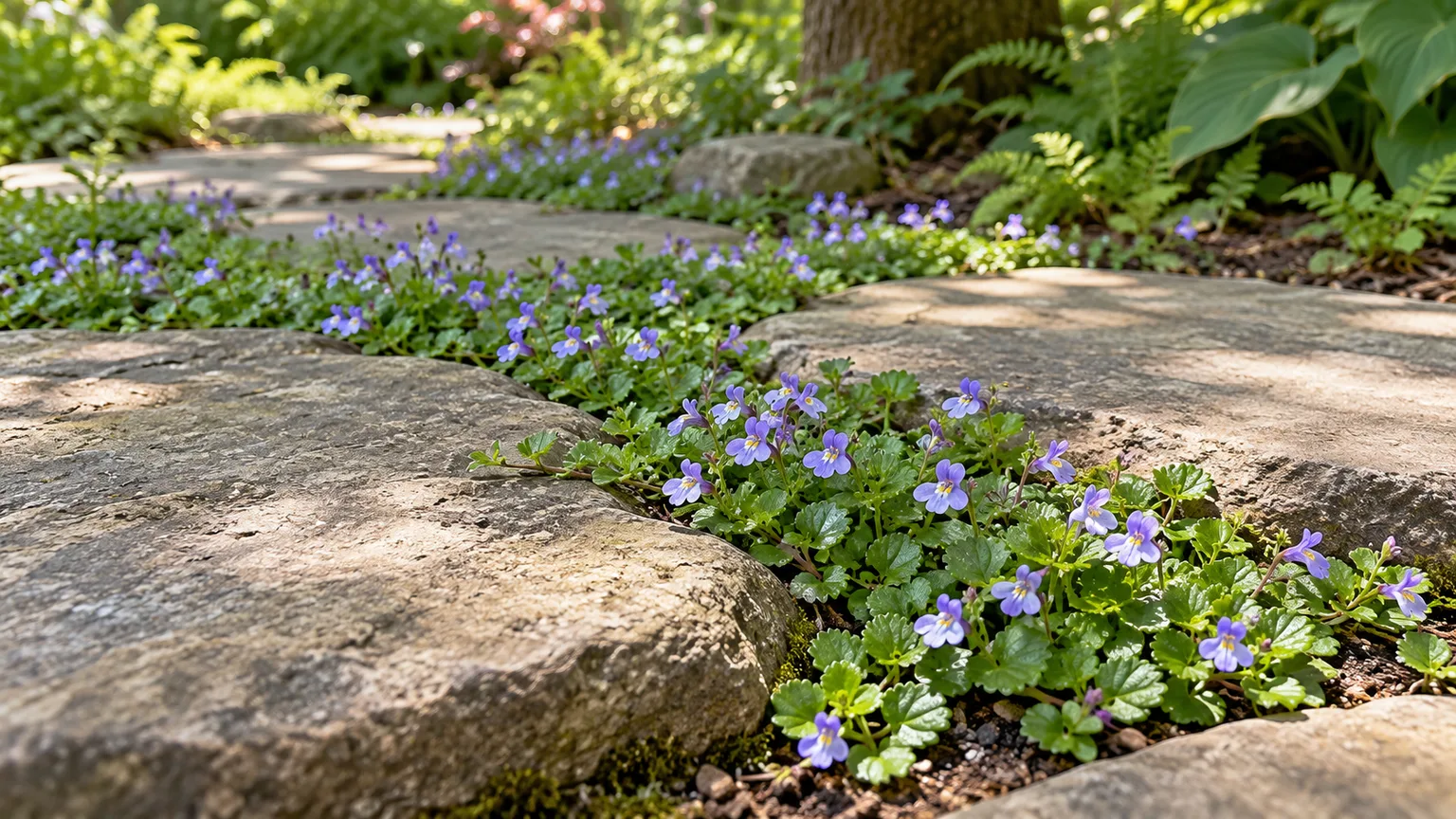
Creeping mazus is a useful groundcover when you need a very low, flowering mat for moist soil, a rock garden, or the joints between stepping stones. It grows by surface runners that root wherever a stem node touches soil, so the same trait that closes bare patches can send growth into nearby beds. The easiest way to succeed is to choose a site that stays evenly moist but drains, give the plant room to spread, and decide where its edges should stop before you plant.
In nursery listings, the plant may appear as Mazus reptans or Mazus miquelii. Both names are used in horticultural references, and the difference matters when you check regional spread guidance. The care below is for the creeping mazus commonly sold as a small perennial groundcover; confirm the botanical label and local recommendations before using it near natural areas.
What Creeping Mazus Looks Like
Creeping mazus is a mat-forming perennial that usually stays only a few inches tall. Small green, spoon-shaped leaves sit close to the soil, while short flower stalks rise just above the foliage in late spring or early summer. The tubular, two-lipped flowers are commonly lavender or blue-violet with pale and yellow markings; a white-flowered selection is also sold. The combination is delicate rather than showy from a distance, but it makes a stone path or rock garden feel softer without hiding the hardscape.
The stems travel sideways over the soil surface and root at their nodes. That gives the plant a fast, self-layering way to fill openings and makes it easy to lift rooted sections for propagation. It is semi-evergreen in mild, sheltered conditions, but colder winters can brown or thin the foliage; expect it to recover from living crowns and runners rather than to look like a pristine evergreen lawn year-round. The Royal Horticultural Society describes the species as a tiny, mat-forming perennial that is nearly evergreen in sheltered spots and blooms in late spring to early summer (RHS plant profile).
Is Creeping Mazus Right for Your Garden?
Choose creeping mazus for a small path, stepping-stone gaps, a moist rock garden, or an open strip where a low mat can spread without smothering taller plants. It can soften the ground around a pond edge or in a rain garden if the soil is damp but still lets excess water move away. Once a planting knits together, it shades the soil and can reduce the number of open places where weeds start, although it will not eliminate established weeds or make weeding unnecessary during the first season.
It can take light, occasional foot traffic, which is different from tolerating a busy route. A person crossing a few times a week or stepping between stones is a reasonable use; repeated daily traffic, children playing, pets racing, or a wheelbarrow route can crush foliage and expose the soil. For a path people use often, let the stones carry the weight and use mazus only in the joints. If you want a lawn replacement, test a small patch first rather than removing a large lawn on the assumption that mazus will behave like turf.
The site matters more than a general hardiness-zone number. U.S. gardening references do not agree on a single range: Better Homes & Gardens lists Zones 5–8, while Cornell Home Gardening lists Zones 3–9. A zone rating is not a guarantee that the plant will thrive through a hot, dry summer. University of Arkansas Extension describes it as a quick-growing plant that prefers bright light with some shade during the hottest part of the day; it also recounts a small campus lawn patch that faded after a few years, with winter cold, summer dryness, and root problems offered as possible explanations rather than a confirmed cause (University of Arkansas Extension). Trial a small patch on your actual site before committing a broad area (Cornell Home Gardening, Better Homes & Gardens).
Creeping Mazus Care at a Glance
| Care factor | Practical target |
|---|---|
| Light | Full sun in mild, moist locations; partial shade or afternoon shade in hot summer climates |
| Soil | Moisture-retentive soil that still drains; loam is easiest, but many soil types can work |
| Water | Keep new plants evenly moist; water established mats during prolonged dry spells |
| Planting time | Spring is the simplest choice; early fall can work where roots have time to establish before hard freezes |
| Spacing | About 12–18 inches for individual starts; closer spacing closes gaps sooner |
| Mature habit | A low, spreading mat that roots at stem nodes and may need edge control |
| Flowering | Small blue-violet flowers, usually in late spring or early summer |
| Best uses | Between stepping stones, rock gardens, moist borders, and low-traffic groundcover patches |
These are starting points, not guarantees. NC State Extension reports that mazus grows in full sun or partial shade and prefers consistently moist, well-drained soil; it also notes that runners root at nodes and that the plant can be mowed or used in a rock garden (NC State Extension profile). A sunny location in a cool coastal climate may suit it, while the same exposure in a hot inland garden can dry the shallow root zone too quickly. Use your soil and summer conditions to fine-tune the table.
Give It Light Without Summer Scorch
Creeping mazus flowers best when it receives enough light, but afternoon shade becomes valuable where summers are hot. In a cooler region, a sunny or partly sunny bed can encourage a compact mat and more blooms. In a hot climate, choose a site with morning sun and shade during the hottest part of the day, or dappled light beneath high branches. Deep shade can keep the plant alive, but growth and flowering may be less vigorous.
Pay attention to reflected heat as well as overhead sun. A narrow strip along a south- or west-facing wall, a dark paved patio, or a driveway can become much hotter than an open bed. If the leaves wilt during the day and recover by evening, check soil moisture and heat exposure before adding fertilizer. If scorched patches persist, move new divisions to a cooler spot rather than repeatedly watering a location that bakes dry each afternoon.
Keep Soil Moist but Never Waterlogged
The useful soil description is moist, not swampy. Creeping mazus tolerates more moisture than many drought-adapted groundcovers, which helps explain its use around damp paths and rain-garden edges. But roots that sit in stagnant water can decline. A heavy clay bed can support mazus if water drains away after rain; a low depression that remains submerged or sticky for days is a different condition and is a poor choice.
Loamy soil rich in organic matter makes it easier to hold moisture without turning airless. Before planting, remove perennial weeds and loosen the top several inches so fine roots and runner nodes can contact soil. If the bed is sandy and dries rapidly, work in compost and use a thin organic mulch around, not over, the foliage. If clay stays wet, improve drainage across the planting area or select a raised edge instead of digging a small pocket filled with loose potting mix; that pocket can collect water like a basin.
You do not need to chase a narrow pH target. Better Homes & Gardens describes mazus as adaptable across soil types and notes that it grows faster and flowers more freely in well-drained loam; it lists slightly acidic soil as ideal, but moisture and drainage are the more practical issues to solve first (Better Homes & Gardens growing guide). Test your soil only if other plants show a persistent nutrient or pH problem. A soil test cannot compensate for a site that dries out every afternoon or holds standing water.
Plant in Spring for Even Coverage
Spring planting gives plugs time to root and send out runners before the next winter. Water the nursery pots first so the root balls come out intact, then set each plant at the same depth it was growing in its container. Firm soil lightly around the root ball, water the whole planting bed, and keep the root zone from drying while new leaves and runners appear. Do not bury the crown under mulch; the stems need access to soil wherever they root.
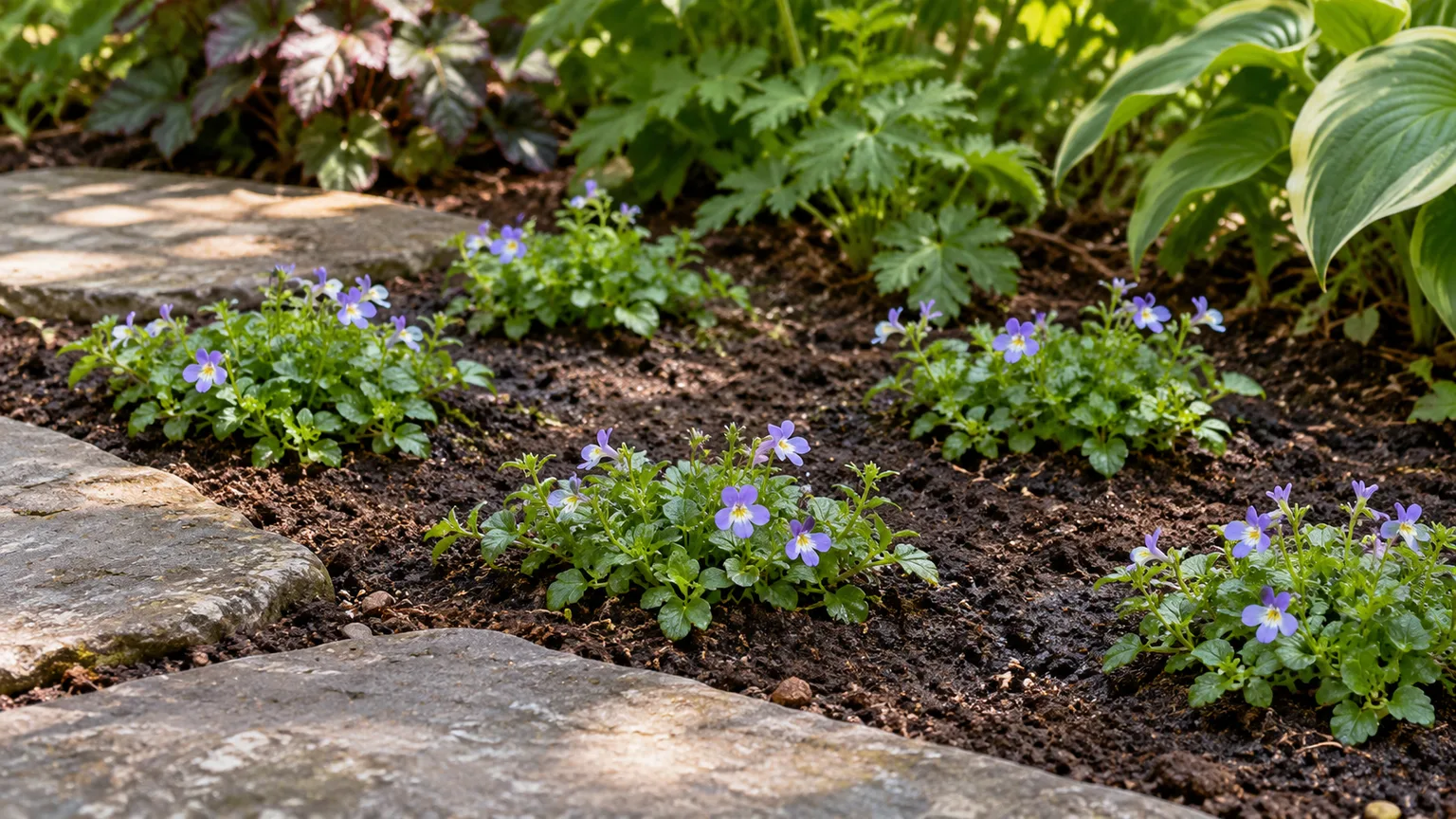
For a strip between paving stones, remove debris and persistent weeds from the joints, then add a little soil or compost where the existing joint mix is too compact or shallow. Set small starts into the openings without forcing them below the stone surface. Leave room for the mat to expand, and keep new plants watered until their runners anchor; a shallow joint can dry much faster than the bed beside it.
If you are converting turf, remove the grass and its roots before planting. Mazus is not a reliable way to seed over an intact lawn because established turf competes strongly for space and moisture. University horticultural references describe mazus as a low-traffic lawn alternative, but the turf replacement still has to begin with bare, prepared ground. A small trial section will tell you whether your watering, winter, and mowing conditions suit it.
Choose Spacing Based on Your Coverage Timeline
Spacing is a trade-off between faster coverage and the price of more plants. NC State Extension and several horticultural guides describe roughly six plants per square yard as a starting density, while nursery guidance often gives plants more room to grow. At six plants per square yard, starts are roughly 15 inches apart on a square grid. Use a closer spacing if you want the gaps to close sooner or have a short planting window; space farther apart when you are covering a large budget-sensitive area and can weed open soil as it fills.
| Spacing approach | When it helps | What to expect |
|---|---|---|
| About 12 inches apart | Narrow path joints or a small area you want to cover sooner | More plants up front and less exposed soil between starts |
| About 15–18 inches apart | General groundcover planting | A moderate plant count with some visible gaps while runners spread |
| Wider than 18 inches | A large area where gradual fill-in is acceptable | Lower starting cost but more time spent watering and weeding open spaces |
Measure the space instead of estimating from the number of pots. A square yard contains nine square feet, so six plugs per square yard works out to about two-thirds of a plug per square foot. Irregular stone joints may need fewer plants than a solid bed because the stones define the edges and the runners can follow the narrow soil channels.
Water During Establishment and Summer Dry Spells
New transplants need more attention than a mature mat. For the first few weeks, check the soil around each root ball and water when it begins to dry; the surface can look damp while the root ball has already dried out. Slow watering helps soak the narrow root zone without washing soil from between stones. Once runners begin rooting in nearby soil, the plant can draw moisture from a larger area and usually needs less frequent attention.
Established mazus still dislikes extended drought. Check a few inches below the leaf mat during a hot, rainless stretch; if the soil is dry, water deeply enough to wet the root zone, then let excess drain. Better Homes & Gardens suggests about an inch of water per week where rain is insufficient, but treat that as a rough starting point rather than a fixed schedule because shade, soil texture, rainfall, and heat change how quickly a bed dries.
Avoid daily shallow sprinkling that wets the leaves but not the roots. If the soil is already saturated, more water will not help a plant with browning foliage. Check drainage first and look for a soggy smell or soft roots. Conversely, if only the edges of a path turn brown and the soil there feels powdery, direct water toward those exposed margins; stone and pavement can increase heat and moisture loss.
Keep Routine Feeding and Trimming Modest
Fertile soil usually does not need a fertilizer program. Excess nitrogen may push soft leafy growth without fixing poor drainage, dry soil, or insufficient light. If growth stays weak after the site and watering are right, top-dress lightly with finished compost in spring and observe the response before reaching for a concentrated fertilizer. Keep compost off the crowns and runners so new nodes can contact the soil.
Pruning is mostly optional. Remove dead or damaged pieces and trim wandering runners where they cross a path or enter a bed. If a large patch becomes shaggy after flowering, mow or shear only after it is established and use a high setting; Better Homes & Gardens advises a mower setting of at least three inches for a lawn-style planting. Test a small edge first because mower decks, terrain, and patch density differ. Do not scalp a short, newly planted mat or mow when the soil is saturated, and remember that frequent mowing removes flowers.
Propagate Rooted Runners or Divide a Mat
The simplest way to multiply creeping mazus is to move a runner that has already rooted. Find a stem node where roots have entered the soil, cut the stem on either side of that node, and lift the small rooted section with a trowel. Replant it at the same depth in moist prepared soil, firm the soil around it, and keep it evenly damp while it settles. A length of stem without a rooted node may survive, but it is less dependable than a piece that already has roots.
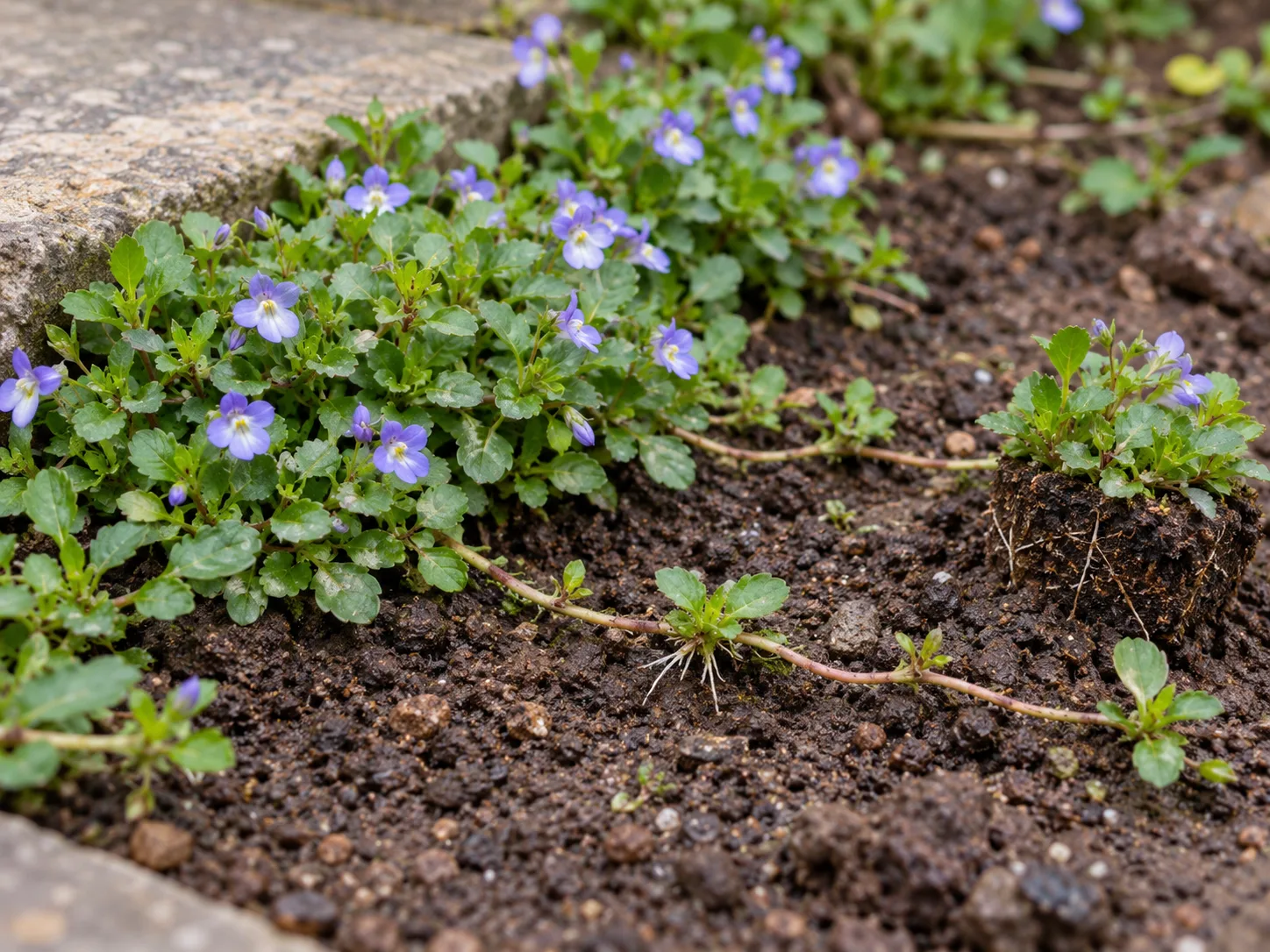
For a broader move, divide a section of the mat in early spring as new growth begins. Water the area the day before if the soil is dry, then use a sharp spade to cut a small plug that includes foliage, rooted runners, and soil. Lift it with as much of the root zone intact as possible, replant promptly, and water both the new division and the parent patch. Division produces a plant that matches the parent, which matters if you bought a white-flowered selection or another named form.
The plant can also be grown from seed, but that is usually less convenient for filling a bed than purchasing starts or moving divisions. Seed-grown plants can vary, and a packet may not preserve the traits of a named cultivar. If seed is your only option, follow the supplier’s sowing instructions for that seed lot rather than assuming that a seed packet and a rooted plug behave the same way. For fast, predictable coverage, choose plugs or rooted pieces.
Grow Creeping Mazus in Containers
A wide, shallow container suits the plant’s spreading habit better than a narrow, deep pot. Use a container with drainage holes and a moisture-retentive potting mix that still drains freely. Plant one or more starts near the edge if you want them to trail, but keep the pot on a surface where rooted stems can be trimmed before they enter neighboring containers or ground beds.
Container soil dries faster than garden soil, especially on a sunny patio or in a hanging basket. Check it regularly during warm weather and water when the top layer begins to dry; do not leave the pot standing in a saucer of water. In cold climates, roots in containers experience more freeze-thaw stress than roots in the ground, so place the pot in a sheltered area or protect the root ball during hard freezes. If your winters are severe, treating mazus as a seasonal container accent may be more reliable than expecting an exposed pot to overwinter unchanged.
Adjust Care Through the Seasons
In spring, remove loose winter debris, inspect the edges, and plant or divide before summer heat arrives. New growth is a useful signal that the patch has resumed activity; delay heavy trimming until you can see what survived. If an older mat has become thin in the center, lift and divide healthy outer sections into the gaps rather than feeding the whole bed automatically.
During late spring and early summer, flowers rise above the foliage. Keep newly planted areas moist, and avoid mowing or shearing while you want the bloom display. In the hottest part of summer, watch the shallow edges and exposed stone joints for dry soil; a bed can remain damp in the center while perimeter plants wilt.
In autumn, do not force lush growth with late fertilizer. Remove leaves only if they smother the mat, and avoid piling wet debris over the crowns. In winter, some foliage may bronze, thin, or die back, particularly in colder or exposed locations. Wait until spring growth begins before deciding that brown winter foliage means the whole planting is dead; surviving rooted nodes may fill the patch again.
Diagnose Gaps, Brown Patches, and Poor Flowering
A thin patch usually points to a mismatch between the plant and the site, not a need for more fertilizer. Check the soil moisture first, then drainage, light, and competition. If the area is crowded by grass or weeds, clear the competition around the mazus; if it sits beneath a thirsty tree, try a small division at the outer edge of the canopy where rain reaches the soil more reliably.
Few flowers can follow deep shade, drought, or an overly vigorous recent trim. Move a small division to brighter morning light if the existing site stays damp but produces mostly leaves. If the whole patch is lush but flowers are brief, that may simply reflect the short late-spring to early-summer flowering window rather than a care failure. The blooms are small, and heavy mowing during that window can remove them before they are noticeable.
Separate Drought Stress From Root Problems
Brown edges and wilt during a dry spell often indicate moisture stress, especially beside hot paving. Feel the soil beneath the foliage: dry, crumbly soil points toward water shortage, while a wet, sour-smelling pocket suggests poor drainage or root decline. Adjust the cause, not just the symptom. Water deeply when the bed is dry; if it stays saturated, improve the site or move healthy pieces to a better-drained location.
Winter dieback can also leave brown patches that look alarming in early spring. Give the patch time to produce new leaves before removing it, then test a small area for living green crowns or rooted nodes. If the surrounding mat is healthy, replant a few rooted divisions into dead gaps; if decline keeps spreading in the same wet pocket, replacing the site may be more effective than repeatedly replanting it.
Manage Slugs and Snails in Dense Foliage
Slugs and snails may hide in the cool, moist cover and chew irregular holes in leaves, although serious pest problems are not the usual reason a mazus planting fails. The RHS lists slugs and snails as possible pests, while describing the plant as generally disease-free. Look beneath stones and dense debris at dusk or after rain to confirm the culprit before taking action.
Remove hiding debris that is not needed for moisture retention, hand-pick pests when practical, and avoid keeping the bed waterlogged. These steps preserve the damp soil the plant likes while reducing places where slugs shelter. If you consider a bait or other control, follow the product label and local guidance, especially where pets, children, or wildlife may reach the planting.
Understand Spread, Invasiveness, and Containment
Creeping mazus is deliberately fast-spreading in a garden: runners can root wherever they touch exposed soil. It generally fills adjacent bare ground rather than behaving like a tall, climbing plant, but it can crowd small neighbors and spill down a wall or into a lower bed. Define its boundary with a stone edge, a path, or routine runner trimming, and inspect those edges during the growing season before rooted sections become harder to lift.
There is no universally safe yes-or-no answer to whether “mazus” is invasive. Mazus reptans and M. miquelii are treated as synonyms by some references, while other sources discuss them separately. The University of Arkansas Extension explains that plant labels and taxonomy have been confused; NC State Extension’s profile under M. miquelii notes that the plant is considered an invasive weed in some northern states. That warning should not be generalized to every state or ignored because a nursery used a different name. Check your current state or regional invasive-plant list under both scientific names before planting, and ask your local extension if the listing is unclear.
If local guidance advises against planting it, choose a locally appropriate native groundcover instead. If it is permitted where you live, do not let runners escape into natural areas, woodland edges, or waterways. A patch confined by stonework and checked regularly is easier to manage than a large planting that meets unmanaged soil at its edge.
Conclusion
Creeping mazus is at its best where a low mat can spread through moist, well-drained soil and receive enough light for spring flowers without baking in summer heat. Plant nursery starts in prepared, grass-free ground, keep them moist while their roots establish, and use rooted runners or division to fill gaps. It can soften stones and handle light passage, but it is not a durable sports lawn or a plant to use without checking local spread guidance.
Before you buy, confirm the label, look up regional recommendations under both Mazus reptans and M. miquelii, and try a small patch if your climate is extreme. With the right moisture, a little edge control, and modest care, the mat can spread where you want it and stay manageable.