How to Grow and Care for Climbing Aloe Indoors and Out
Grow climbing aloe with clear advice for outdoor fences and indoor containers, including watering cues, pruning, cuttings, flowering, and common problems.
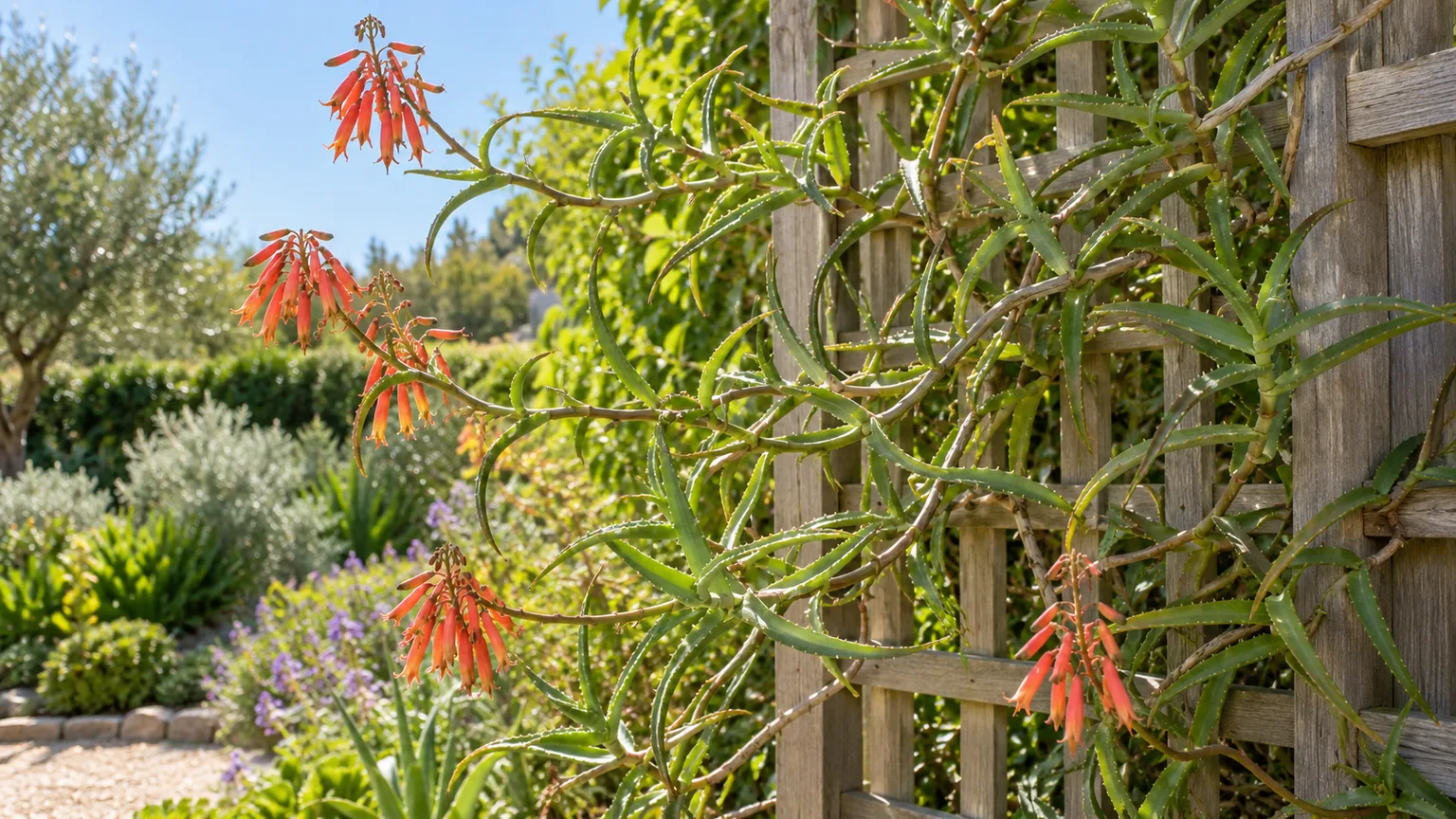
Climbing aloe is a sun-loving succulent with a very different shape from the compact rosette most people picture when they hear “aloe.” Its long, slender stems scramble through nearby shrubs or along a fence, and in a warm garden they can grow far beyond the footprint of a small patio plant. Give those stems a sturdy support, bright light, and a root zone that drains freely, and the plant can reward you with orange-red flowers.
Its currently accepted name is Aloiampelos ciliaris; some nurseries and older references still use Aloe ciliaris. Kew describes it as a succulent shrub native to South Africa’s Eastern Cape, while the South African National Biodiversity Institute (SANBI) describes stems that can climb to about 10 metres in suitable conditions. That is potential reach, not a container-size promise: indoor plants grow more slowly and need pruning to stay within their space. (Kew’s Plants of the World Online profile; SANBI PlantZAfrica profile)
The useful starting rule is simple: decide where the plant will spend winter before you put it in the ground. In a frost-free garden, let it scramble on a fence or strong trellis; where freezes are possible, grow it in a broad container you can move to shelter. In either setting, water according to how quickly the soil dries rather than following a weekly schedule.
Is climbing aloe actually a climber?
Climbing aloe does not cling to walls with adhesive pads or wrap around a support with tendrils. It is a scrambling succulent: its slender stems lean into nearby vegetation, and SANBI notes that stems resting on the ground can root. In a garden, that habit makes a fence, large shrub, or freestanding trellis useful, but you will need to guide the plant rather than expect it to attach itself securely.
Look for green stems with narrow, fleshy leaves arranged along them and small white teeth that continue around the base of each leaf. The flowers are tubular and reddish orange, usually appearing in loose clusters near stem tips. Kew describes stems up to about 10 metres long in the wild; SANBI notes a spring flowering peak, with flowers possible through much of the year in a suitable climate. (Kew’s species profile; SANBI’s description and cultivation notes)
This distinction also helps you interpret generic aloe advice. The Royal Horticultural Society notes that climbing species have been moved out of the genus Aloe, and its general aloe guide cautions against shade and continuously wet compost. Those are useful broad principles, but compact aloe vera care charts are not a complete recipe for a fast-growing, stemmed species. Fine Gardening’s genus guidance likewise favors full sun and free-draining soil; for climbing aloe’s size, flower season, and propagation, use species-specific information. (RHS aloe guide; Fine Gardening’s aloe profile)
One safety point belongs in the planting decision: Kew lists the leaves as harmful if eaten by people or animals. Keep the plant out of reach of pets and curious children, and do not treat it as an edible or medicinal aloe just because another aloe is used that way. (Kew’s species profile)
Outdoor or container? Choose by winter risk
Grow it outside where frost is rare
Choose a sunny spot with enough vertical and lateral room for a scrambling plant. A fence is useful if it is sturdy and has a trellis or wires that give the stems several points of support. Avoid placing it where long stems will spill across a narrow walkway, snag people, or shade a smaller plant you want to keep compact.
SANBI recommends planting climbing aloe at the base of a shrubbery or fence and reports that it can thrive in high-rainfall areas when planted in a well-drained position. It also gives about 1.5 metres as a spacing interval along a fence for cuttings. Use that as a starting layout rather than a strict rule: give each plant more room where you want separate, easy-to-prune clumps, and less only if a dense screen is the goal. (SANBI’s cultivation profile)
The species is associated with dry river valleys and thorny thicket, but “drought-tolerant” does not mean it needs a dry climate. It stores water in its leaves and stems; the essential condition is that roots do not remain in stagnant water. In a wet climate, drainage, a raised planting position, and air movement matter more than withholding every drink.
Use a container where winter freezes
Plant in a container if you need to move the aloe before cold weather or if your garden soil stays wet. Put the pot on a sunny patio in warm months, then bring it into a bright, sheltered space before freezing conditions. Kew says the plant will not tolerate frost, so treat a forecast freeze as a reason to act early rather than wait to see whether a large plant survives it. (Kew’s species profile)
Indoors, give it the brightest available position, ideally close to a large window with direct sun for part of the day. It will usually remain smaller and may flower less reliably than an outdoor plant in a warm, bright climate. A container also needs a support that will not tip as the stems lengthen; a lightweight nursery pot and a tall, unanchored stake are a poor combination.
If the plant spends summer outdoors, move it into direct sun gradually after a long indoor winter. Give it brighter exposure over several days instead of placing tender indoor-grown leaves in the strongest afternoon sun all at once. That short acclimation period reduces the chance of sun-scorched patches while still moving the plant toward the bright conditions it needs.
Give climbing aloe the brightest light it can use
For outdoor planting, aim for full sun once the plant is established and acclimated. SANBI notes that climbing aloe’s flower clusters extend fully in full sun, and Fine Gardening’s broader aloe guidance also lists full sun as the default. In very hot climates, a position with light afternoon shade can reduce stress on a container, but too much shade commonly produces loose, stretched growth and fewer flowers. (SANBI PlantZAfrica profile; Fine Gardening’s aloe profile)
Indoors, window direction is only a rough guide because nearby buildings, trees, and the season change the actual light. Put the pot where the stems can see bright sky and receive several hours of direct sun if possible; in the Northern Hemisphere, an unobstructed south- or west-facing window is often a practical starting point. Rotate the pot periodically if one side keeps leaning toward the glass.
Use the shape of new growth to decide whether the light is adequate. Long spaces between leaves, thin pale stems, and a plant that bends toward one window point to insufficient light. If the stems are green and compact but simply lying sideways, light may be adequate and the missing ingredient is support. Moving a plant to a brighter position may help stretched growth, but it will not make an unsupported stem attach to a trellis.
Build drainage into the root zone
The species has a shallow, spreading root system that uses the upper soil layer. That makes it important to protect the crown and roots from prolonged saturation, but it does not mean the plant should be starved in a sterile pile of gravel. SANBI describes the native root zone as using the upper humus-rich soil and says the species tolerates a broad range of soils when drainage is good. (SANBI PlantZAfrica profile)
Prepare an in-ground bed and support
Check how water behaves in the intended planting area after rain. If it puddles or stays slick and wet for days, choose a raised bed, a gentle slope, or a container instead. Improving a planting hole with a small pocket of gritty mix can backfire in heavy clay if the hole becomes a basin that collects water; change the whole root zone or plant above grade rather than relying on a little sand at the bottom.
Set the root ball so its crown sits level with the surrounding soil, not buried under a thick layer of mulch or compost. Leave a clear gap around the base to discourage persistent dampness against the stem. Install a fence panel or trellis before planting if doing so later would disturb the shallow roots.
Where the soil drains freely, a modest amount of finished compost worked into the planting area can support growth. Do not turn the root zone into a rich, soggy bed; the plant is succulent and can cope with leaner soil better than it can cope with stagnant water. If the only reliably draining spot is sunny and somewhat exposed, that is usually a better starting point than a shaded, waterlogged corner.
Choose a stable container and mix
Use a pot with unobstructed drainage holes and a broad base. Because the roots spread close to the surface, a wide container is more useful than a very deep narrow one. Choose a pot just large enough to hold the root system with room for new growth; a container several sizes too large can hold a much larger volume of wet mix than the roots can use, especially indoors.
A commercial cactus and succulent mix can work, but check whether it drains freely rather than forming a dense, peat-heavy plug. If it stays wet for too long, amend it with pumice, perlite, or coarse horticultural grit. A practical starting blend is roughly two parts succulent mix to one part mineral amendment, adjusted for the mix and your climate: add more grit if the pot remains damp, and less if water runs straight through without moistening the root ball.
The RHS recommends good-quality cactus compost or another suitable compost with sharp grit for container aloes; apply that as a broad container principle, not a species-specific formula. Do not add a gravel layer under the potting mix as a substitute for drainage holes. Empty any saucer after watering so the root zone never sits in runoff. (RHS aloe guide)
Water deeply, then let the soil reset
Water the root ball thoroughly, then wait for the upper root zone to dry before watering again. In a pot, pour slowly until water runs freely from the drainage holes, then empty the saucer. In the ground, a long soak during a warm dry spell is more useful than frequent surface sprinkling, but rainfall may supply all the water an established plant needs.
Use the soil rather than the calendar. Push a finger or wooden skewer a few centimetres into the mix; if it still feels cool and damp, wait. When the upper few centimetres have dried and the pot feels noticeably lighter, water again. A small new cutting has less root volume than a mature plant and may need closer observation while it establishes, but it still should not sit in saturated mix.
Expect the interval to change with light, temperature, pot material, soil mix, and season. A sunlit outdoor pot in hot, windy weather can dry far sooner than a large plant in an indoor room during winter. A plant receiving little light uses water more slowly, so using the same interval year-round is a common route to rot.
This plant can grow in high-rainfall gardens if drainage is good. That is not a contradiction: rainfall can be frequent while water still moves through soil and away from the roots. If the soil stays wet, fix the drainage or move the plant rather than trying to manage an unsuitable site by guessing a smaller amount of water each time.
Drooping leaves alone do not tell you whether the plant needs water. First check the medium and the stem base: a dry, firm plant may need a deep drink, while soft, dark, or collapsing tissue in wet soil points toward rot. Correct the cause you can observe, then give the plant time to respond rather than changing the light, water, soil, and fertilizer all at once.
Feed lightly and anchor the stems
Climbing aloe is naturally vigorous, so it does not need a heavy fertilizer routine to become larger. SANBI reports that it responds well to organic matter such as compost. For an in-ground plant, a thin spring top-dressing of finished compost around the root zone is a gentle option; keep it away from direct contact with the stem base. (SANBI’s cultivation notes)
For a container plant that has been in the same mix for a long time, a diluted succulent fertilizer during active growth can replace nutrients. Follow the product label and do not feed a dry or stressed plant, a plant with suspected root rot, or one that is resting through cool, dim weather. More fertilizer will not fix weak light, wet soil, or a missing trellis.
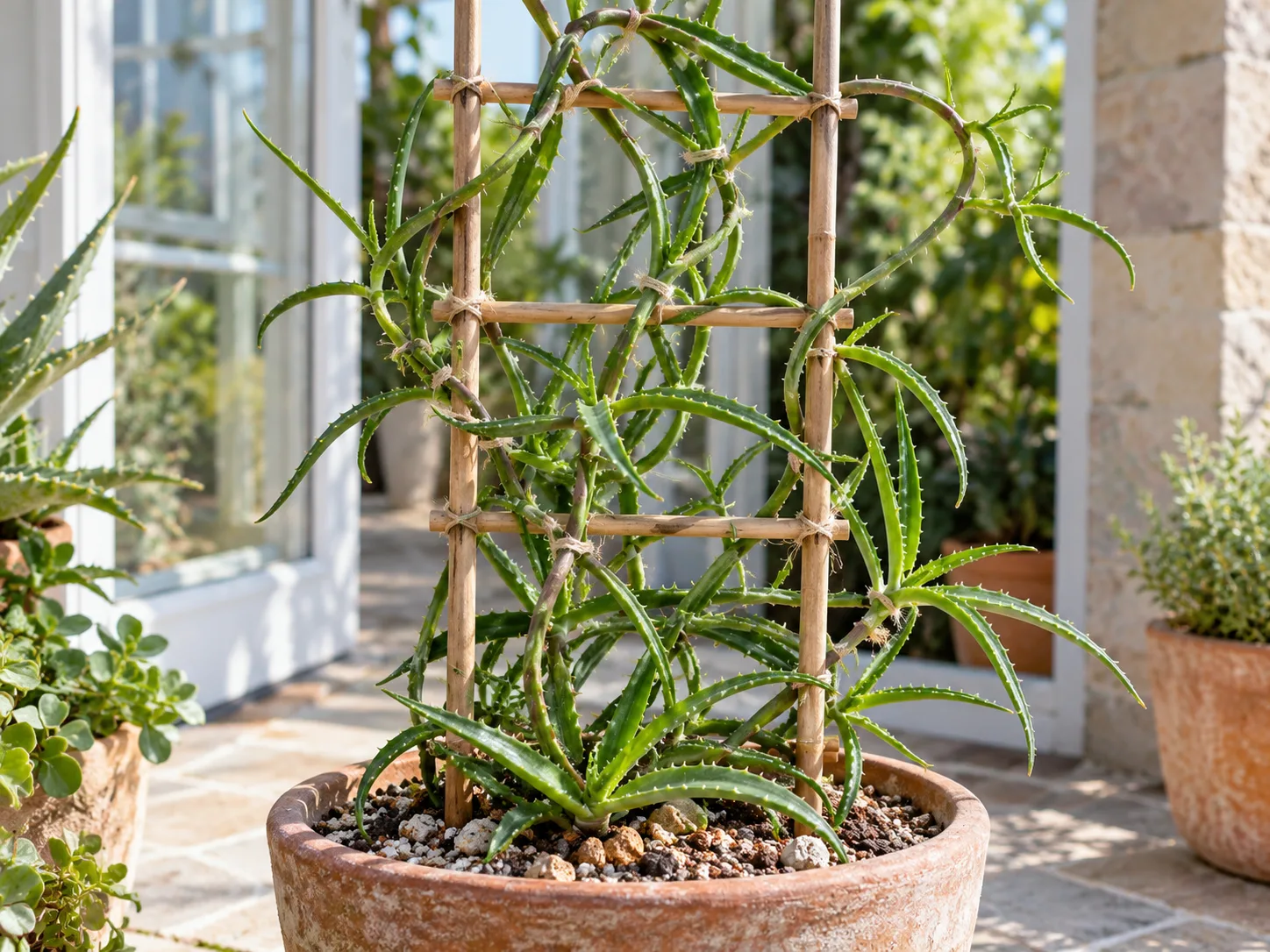
Set up the support while the plant is young enough to guide without force. A sturdy fence, open trellis, or obelisk gives the long stems places to lean; for a container, choose a support that is anchored securely to the pot or to a nearby structure. Put ties around the stem loosely in a figure eight, with the tie separating stem from support so it does not pinch as the stem thickens.
The stem is not a rigid vine that can be bent sharply around each rung. Guide new growth in the direction it naturally points, add a few gentle ties, and prune a section that has become too long rather than hauling it into a tight turn. The support’s job is to prevent breakage and give the plant a tidy route, not to force every stem into a perfect grid.
Train and prune before the stems tangle
Inspect the plant a few times during its active season and redirect stems while they are still manageable. Tie only enough to prevent a stem from dragging or snapping; dense, tight lacing can trap moisture and make future pruning difficult. If the main support has run out of room, shorten the longest stems or add another support before the plant blankets neighboring shrubs.
Prune out dead, damaged, crossing, or unwanted stems with sharp, clean shears. Wear gloves if the small leaf-edge teeth catch your skin, and avoid yanking stems free because they can break close to the base. Make a clean cut at a branch junction or just above a healthy node, then remove the cut material from the planting area.
Late winter or early spring is a useful time for a larger tidy-up in climates with a clear growing season, because the plant can resume growth in warm weather. In a mild climate where it grows through much of the year, prune when the plant is actively growing and not under heat, drought, or cold stress. If a long stem is already top-heavy, support the remaining plant before cutting it in sections so the weight does not tear the base.
Climbing aloe often flowers near the ends of branches, so avoid cutting off every healthy stem tip just before the season when it normally blooms. If you want to keep the plant compact, accept that frequent hard pruning can reduce flowers on the stems you remove. Save healthy cut sections as propagation material rather than discarding them.
Propagate from stem cuttings or seed
SANBI describes climbing aloe as easy to propagate by cuttings or seed, and notes that a branch can be planted in a container or garden. For most home growers, a stem cutting is the quicker, more predictable way to make another plant. A seed-grown plant is useful when you want several plants or enjoy growing from the beginning, but it takes longer to reach flowering size. (SANBI PlantZAfrica profile; Fine Gardening’s aloe propagation overview)
Stem cuttings: the practical route
Take a firm, healthy, non-flowering stem from a plant that is growing actively. Use a clean blade and choose a section long enough to include several leaf nodes. Remove leaves from the lower portion that will sit in the mix, then place the cutting in a dry, airy spot out of direct sun until the cut surface has dried and callused; the time varies with stem thickness and weather.
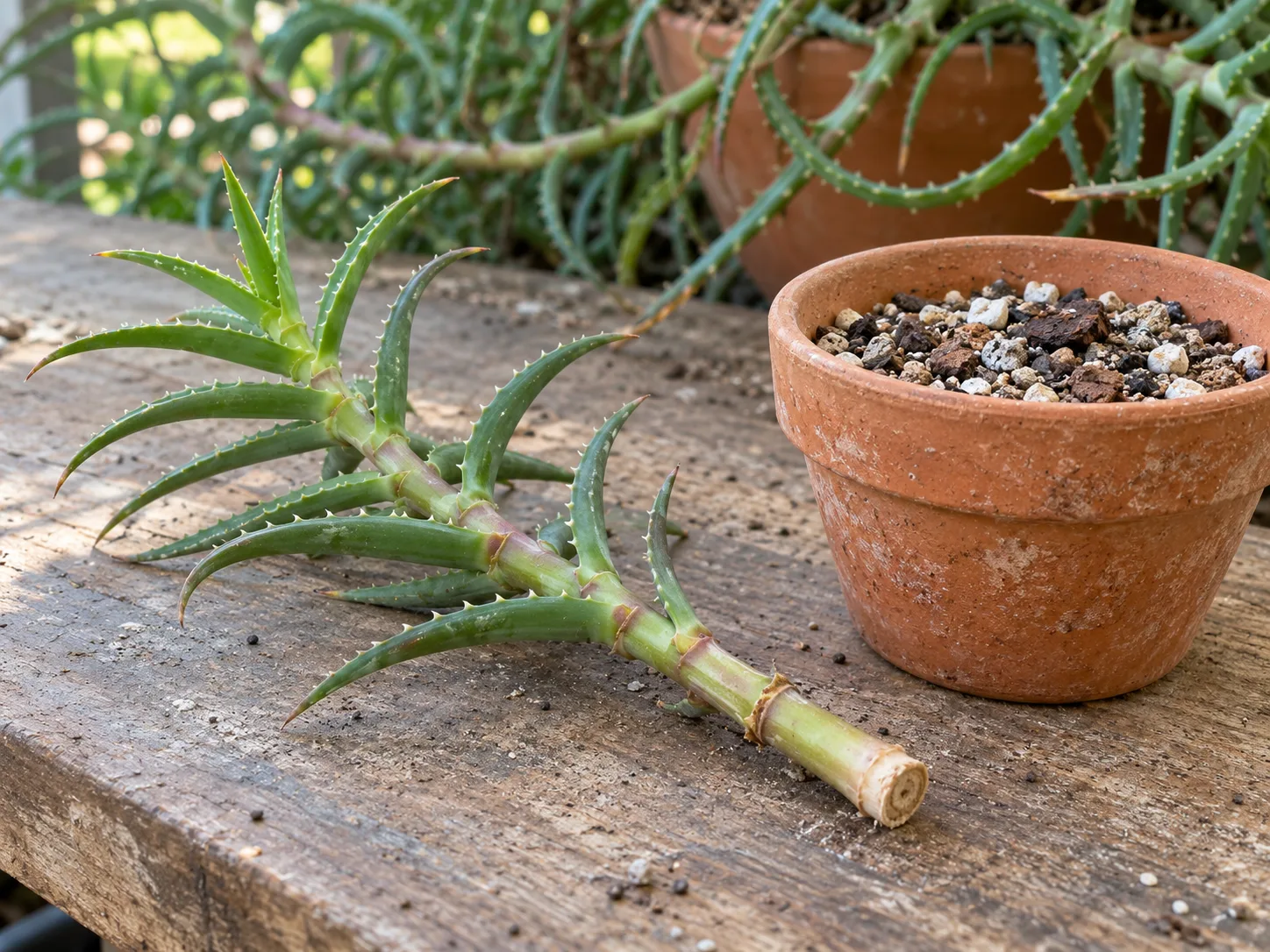
Set the callused base into a small pot of freely draining succulent mix, deep enough to hold the stem upright without burying a large section. Keep the pot in bright light but out of harsh midday sun while roots form. Let the mix dry between light waterings; a cutting with no roots cannot use a constantly wet pot, and excessive moisture can rot its cut end before it establishes.
Do not pull the cutting up every few days to check for roots. Look for firm new growth and gentle resistance when you lightly test it, then move it into stronger sun gradually. Once rooted, tie it to a small stake or the base of its permanent trellis so wind or handling does not loosen the new roots.
In a frost-free garden with well-drained soil, SANBI says cuttings can be planted directly at the base of a support. Starting them in a small pot is more controllable if rain is frequent, the bed is cold, or you are unsure whether the soil drains well. Neither approach requires a leaf cutting: climbing aloe is grown from a section of stem, not from a detached fleshy leaf as some readers try with other succulents.
Seed: the slower route
Sow fresh seed in spring or summer in a tray of sandy, well-drained medium. SANBI recommends a warm, shaded position, a very thin sand cover of about 1–2 millimetres, and steady moisture without saturation. Germination can occur in roughly three weeks in suitable conditions, after which you can move seedlings into individual containers when they are large enough to handle. (SANBI’s seed-growing instructions)
Keep young seedlings in bright shade while they establish, then increase sun exposure gradually. Do not leave a seed tray in full, drying afternoon sun or keep it sealed in a humid cover after germination; both extremes can set seedlings back. SANBI reports that seed-grown plants may flower in about two to three years, but growth and flowering timing vary with light, warmth, and care.
Why climbing aloe may not flower
The most common fix for a climbing aloe that grows but does not flower is better light, not a stronger fertilizer. Flower clusters appear near the ends of mature branches, and SANBI reports a spring peak with flowering possible for much of the year. A plant in a bright, warm outdoor position is more likely to bloom freely than one spending the year in a dim room. (SANBI PlantZAfrica profile)
Check the plant’s age and recent pruning before changing its care. A young plant may be building stems and roots before it produces flowers, while a mature plant that was heavily shortened may need time to grow new flowering tips. If you cut every stem end back each spring, keep a few healthy branches intact so the plant has places to flower.
Then check for environmental stress in this order: is the plant receiving strong light, is its root zone draining, and is it protected from frost? A plant that stays wet, grows in shade, or repeatedly suffers cold damage may spend its resources recovering instead of flowering. Once those basics are right, a light spring compost dressing can support growth, but fertilizer cannot substitute for sun or maturity.
Do not assume that a missed bloom means the plant is failing. Indoor climbing aloe may remain healthy without flowering, and timing depends on the conditions it receives. Focus first on firm new growth, stable support, and sound roots; flowers are a useful signal of maturity and favorable conditions, not the only measure of success.
Diagnose pests, rot, and weak growth
Change one condition at a time and use the plant’s texture, soil, and growth pattern as evidence. The symptoms below are clues rather than diagnoses; a single drooping leaf can have several causes, so check the root zone and stem before treating the plant.
| What you see | First check | What to do next |
|---|---|---|
| Thin, stretched stems with wide gaps between leaves | Light level and direction of new growth | Move toward brighter light gradually; keep the stems supported while new growth compacts. |
| Firm green stems falling sideways | Whether the plant has a trellis or loose ties | Add support without tightening ties; do not water more just because the plant leans. |
| Soft or dark stem base, wet mix, or a sour smell | Drainage holes and how long the mix stays wet | Unpot if needed, remove rotted material with clean shears, and restart healthy sections in fresh, dry-draining mix. |
| Shriveled leaves in a light, dry pot | Moisture several centimetres below the surface | Water thoroughly once, then wait for the mix to dry again; do not give frequent sips. |
| White cottony clusters or small fixed brown bumps | Leaf bases, stem joints, and sheltered parts of the plant | Isolate a container plant, remove a small infestation manually, and repeat inspections; use only a plant-labeled treatment as directed if needed. |
Mealybugs can hide where leaves meet the stem, and scale can resemble small bumps attached to stems or leaves. Fine Gardening lists mealybugs and scale among common aloe pests and root rot among the problems to watch for. Inspect sheltered joints when pruning or tying the plant, and avoid spraying an already stressed plant with several untested products. (Fine Gardening’s aloe profile)
If a cutting or plant base is soft, do not treat it as ordinary thirst. Remove it from persistently wet soil, cut away mushy material with a clean blade, and keep any firm, healthy stem sections as cuttings. If the main base is entirely soft or the rot has reached all healthy stems, recovery may not be possible; saving a sound stem early is more realistic than trying to revive every damaged part.
If the plant looks weak but the roots are firm and the mix drains, stop making several changes at once. Improve the light or add support according to the symptom, then watch the next few weeks of growth. A plant that is stretched will not compact old stems again, but it can produce stronger new growth in better light.
Conclusion
Climbing aloe is easiest to grow when you plan for its two defining traits: long, scrambling stems and roots that dislike standing water. In a warm, frost-free garden, give it sun and a sturdy fence or trellis; in a colder climate, choose a broad, well-drained pot that can move indoors before frost. Water thoroughly only after the upper root zone dries, and use support and measured pruning to keep its growth where you want it.
For a healthy plant, choose the brightest position you can provide, feed lightly, and propagate from stem cuttings when you need another. If growth becomes floppy, inspect light and support before watering; if it becomes soft at the base, fix drainage first. With those decisions in place, the plant’s fast, graceful stems and orange-red flowers can be an asset rather than a tangle.