Leggy Growth on Aglaonema Cutlass: Ribbon Leaf Fixes
Quick answer
Leggy Aglaonema Cutlass shows elongated petioles between narrow silver-veined lance leaves, a lean toward the brightest light, and a tall soft clump instead of a dense ribbon crown. First step: move the pot to the brightest filtered indirect spot you can offer today, then read the next leaf for tighter spacing before pruning.
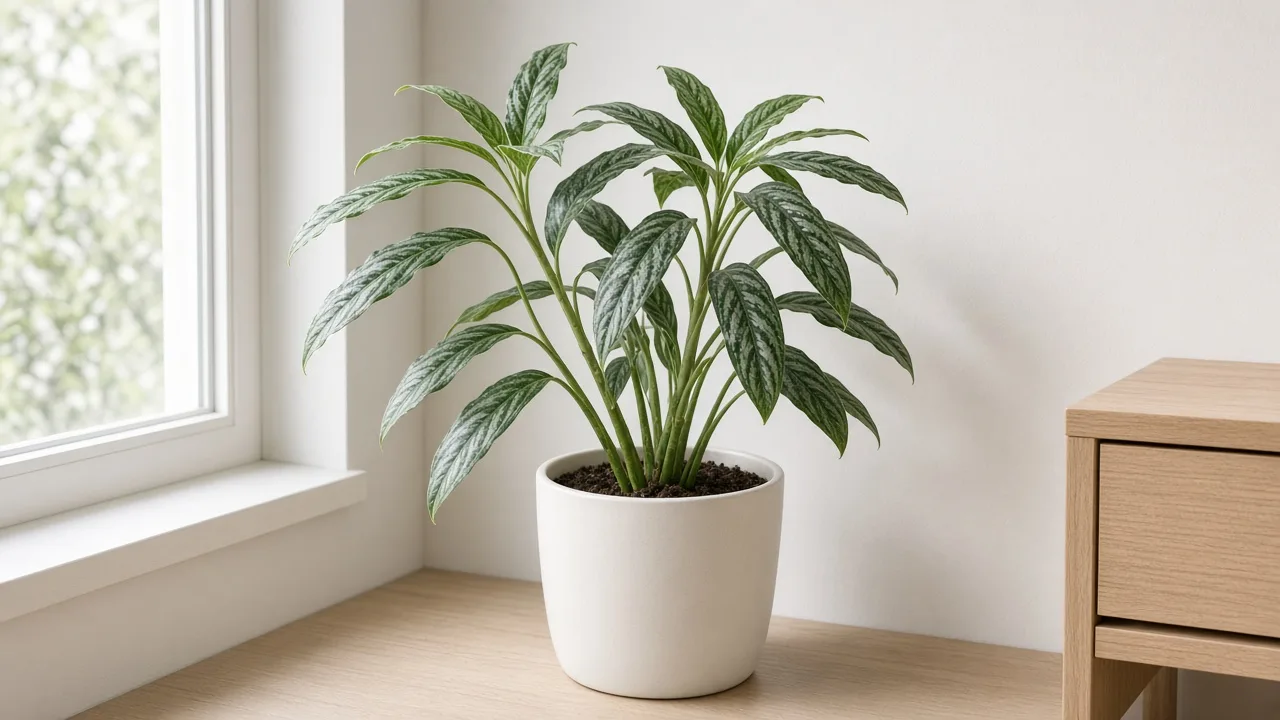
Leggy Growth on Aglaonema Cutlass: Causes, Checks & Fixes
This guide covers leggy growth on Aglaonema Cutlass. See also the general Leggy Growth guide, watering, and light pages for this plant.
Leggy Growth on Aglaonema Cutlass: Causes, Checks & Fixes
Quick answer
Leggy growth on Aglaonema commutatum ‘Cutlass’ is etiolation—the ribbon Chinese evergreen stretching toward whatever photons it can find. Cutlass earns its reputation for genuinely low indoor light and office fluorescents, but low-light tolerant is not the same as no light. In a truly dim interior—a desk facing a wall, a hallway shelf, or a north room in winter—long bare petioles appear between narrow lance blades, silver vein marbling dulls toward plain dark green, and the whole clump leans toward the brightest direction in the room.
For how etiolation works in general, see our leggy growth hub. On Cutlass, the telltales are wide gaps along ribbon petioles, a one-sided lean toward ceiling panels or a single window, and a tall soft plant where a dense silver-veined clump should sit.
First step: move the pot to the brightest filtered indirect location you can offer today—within a few feet of an east- or north-facing window, several feet back from south or west glass behind sheer fabric, or directly under brighter office ceiling lights. Do not repot, fertilize, or prune heavily on the same day. Give Cutlass two weeks in the new spot and read the next narrow leaf for tighter spacing before cutting anything.
When to use this page vs other Aglaonema Cutlass guides
This page is the stretch-and-structure entry when ribbon shoots grow tall, bare, and one-sided—not when color alone fades or roots fail.
| Pattern | Read next |
|---|---|
| Dim room but stretch not advanced yet | Not enough light |
| Washed-out or pale narrow blades without long petioles | Pale leaves |
| Firm clump, just slow in winter | Slow growth |
| Yellow lower leaves on wet mix | Overwatering or root rot |
| Drooping ribbon blades, not elongated stems | Drooping leaves |
| Ready to shorten canes after light is fixed | Pruning guide |
| Window placement and seasonal adjustments | Light guide |
What leggy growth looks like on Aglaonema Cutlass
Cutlass is a ribbon-type Chinese evergreen: long, narrow lance-shaped leaves with dark green bases and silver marbling along the veins. Healthy plants form a slow, upright, dense clump roughly 50 cm tall—not a tall soft wand with foliage only at the tip. Leggy etiolation changes that silhouette gradually:
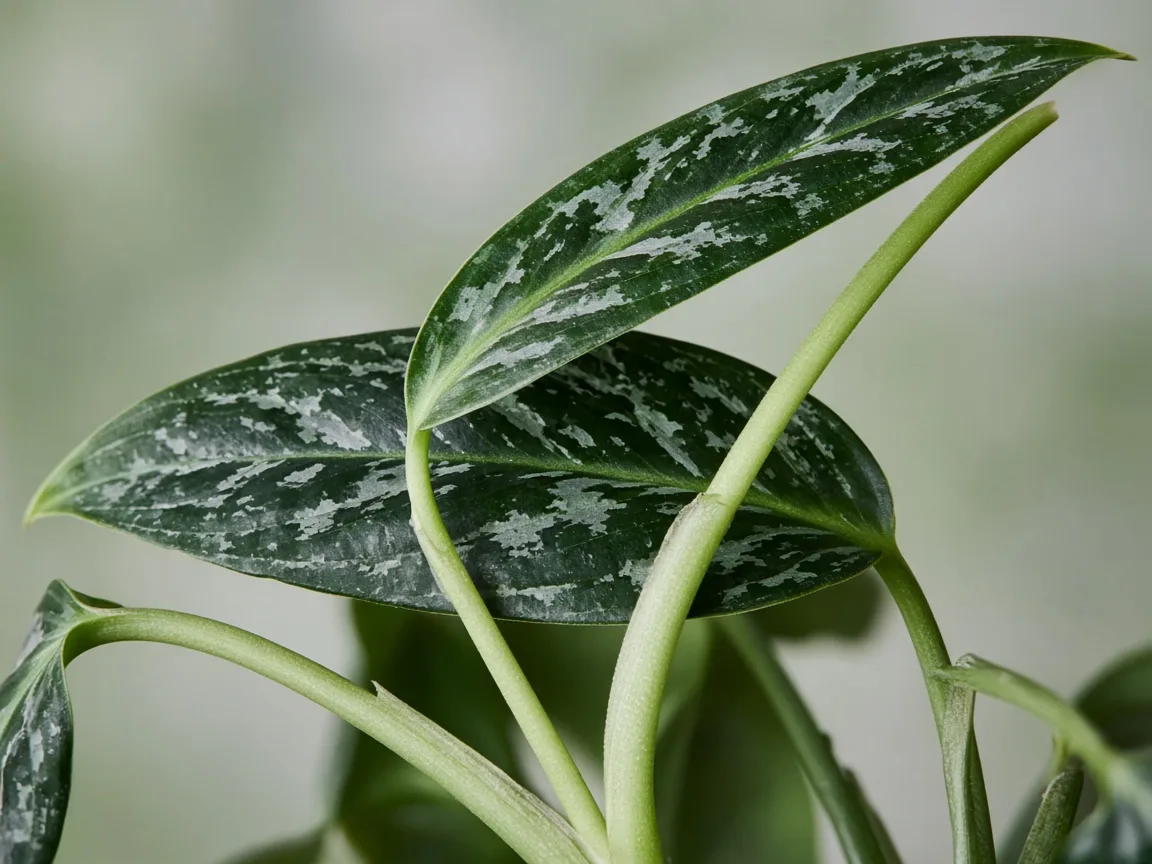
Long bare petiole between narrow lance blades with muted silver veining—compare the wide gap on stretched growth with tighter spacing on the firmer leaf below.
Typical signs on this cultivar:
- Elongated petioles between narrow lance blades — Gaps between leaves widen; the clump looks taller but thinner than when you bought it
- Lean toward one light source — New ribbon leaves and petioles orient toward the brightest window or ceiling panel; the pot may angle with the stretch
- Dull silver vein marbling — Fresh narrow blades lose the crisp silver feathering along veins and read as flat dark green
- Smaller newest lance leaves — The unfolding tip is shorter or narrower than older blades from when the plant was well placed
- Bare lower cane with foliage clustered at the crown — As Cutlass stretches, lower narrow leaves senesce and drop, leaving naked stem with a tuft of small blades on top
- Soft, floppy upper petioles — Stretch weakens structure; ribbon shoots bend toward light instead of standing firm
What leggy growth usually does not look like on Cutlass: bleached tan patches on leaf faces (direct sun scorch after a sudden move to hot glass), sudden whole-plant collapse on soggy soil (root rot—often worsened by low light plus overwatering), or a short dense clump with crisp silver veining and no lean (that is normal slow growth, not etiolation).
Ribbon petiole spacing vs Cutlass’s slow compact habit
Aglaonema ‘Cutlass’ is bred for efficient photosynthesis in dim rooms, so it stretches more slowly than pink or cream-heavy hybrids—but it still etiolates when light falls below what compact ribbon growth needs. This spacing check is Cutlass-specific:
- Tight petioles, firm narrow blades, no lean — Normal slow Cutlass pace; silver veining stays crisp on new flush.
- Widening gaps on every new lance leaf plus window lean — Etiolation; filtered light is the primary fix.
- Stretch only on the shaded side of a multi-crown clump — Directional shade from a bookshelf or monitor; rotate the pot and improve exposure on the weak side.
- Long petioles plus mix wet ten days or more — Dim light slowed water use; pair with watering checks before assuming hunger or repotting.
This ribbon-internode logic does not apply to caudex succulents or vining pothos with nodes—it is about narrow lance blade spacing on an upright clumping aglaonema.
Why Aglaonema Cutlass gets leggy growth
Chinese evergreens evolved under tropical forest canopies where light is filtered—not absent. When photons run short, Cutlass allocates energy toward height and reach rather than the dense clump growers expect from ribbon cultivars. Clemson HGIC notes Chinese evergreen tolerates low to moderate indirect light but still needs enough brightness to stay bushy.
Plant-specific triggers:
- Misreading “office-proof.” Cutlass handles ceiling fluorescents and north windows better than most colorful Aglaonema, but a cubicle facing a wall or a shelf six feet from glass still etiolates ribbon shoots over months.
- Deep interior placement. Indoor light falls off quickly with every foot from a window. A spot that keeps Cutlass alive is not always a spot that keeps it compact.
- Seasonal daylight drop. Winter shortens day length even when the pot never moves. Stretch that started in late fall often shows as bare petioles by February.
- One-sided window or desk lamp. Ribbon leaves on the shaded side grow longer petioles; the clump develops a permanent lean.
- Overwatering in shade. NC State Extension warns root rot occurs when Aglaonema is overwatered—especially in low light when the mix dries slowly. Yellow lower leaves on wet soil plus stretch need root-zone checks, not just a brighter window.
- Fertilizer without photons. Heavy feeding cannot replace light. An under-lit Cutlass pushed with fertilizer may show burned leaf margins while petioles keep lengthening.
How to confirm the cause
Work through these checks before changing water, food, or pot size:
-
Growth direction — If petioles lean or new narrow blades emerge on the side facing one window or light panel, Cutlass is actively seeking light.
-
Internode spacing — Compare the gap between the two newest lance leaves to gaps lower on the same cane. Widening spacing with each new leaf confirms leggy growth rather than Cutlass’s normal compact slowness.
-
Silver vein trend — Duller marbling on fresh ribbon foliage while older blades still show crisp silver feathering often tracks recent dim placement or seasonal light loss.
-
Window or fixture relationship — Identify the nearest window direction and distance in feet. Interior rooms with no window, or pots more than six feet from glass without a grow lamp, are suspect even for Cutlass.
-
Leaf-size trend — Compare the newest narrow blade to one from six months ago or a purchase photo. Shrinking size plus longer petioles points to etiolation.
-
Soil dry-down speed — In dim conditions Cutlass uses less water. If the mix stays damp ten days or more without wilting while stems stretch, low light may be slowing transpiration—see not enough light before blaming soil alone.
-
Two-week placement test — Move Cutlass to the brightest indirect spot available—never into direct midday sun, which scorches foliage. After two weeks, inspect the next unfolding lance leaf. Tighter internodes confirm light was the bottleneck.
Lookalike symptoms on Aglaonema Cutlass
| What you see | More likely cause | Quick differentiator |
|---|---|---|
| Long petioles lean toward window; wide lance spacing | Leggy growth / low light | Etiolation pattern; silver veining dulls on new blades |
| Short dense clump, firm ribbon leaves, slow new flush | Normal Cutlass pace | No stretch; silver marbling still crisp |
| Yellow lower leaves; soggy mix; sour smell | Overwatering / root stress | Wet soil persists; lean may be mild or absent |
| Whole clump limp on wet soil | Wilting / root rot | Turgor loss, not just elongated petioles |
| Bleached or tan patches on leaf faces | Too much direct sun | Damage on sun-exposed side after sudden move |
| No new leaves all warm season but no stretch | True growth stall | See slow growth guide |
Leggy growth and not enough light overlap on Cutlass—this page focuses on the stretched ribbon shape and pruning recovery; the not-enough-light page walks through full light diagnosis and seasonal prevention.
First fix for Aglaonema Cutlass
Move the pot to the brightest filtered indirect location in your home or office.
Practical targets for ribbon aglaonema:
- East-facing window — One to three feet from the glass; Cutlass typically handles the full indirect day without scorch
- North-facing window — Often sufficient for compact ribbon growth; pull slightly closer in winter
- Office ceiling panels — Move Cutlass directly under the brightest fixture row, not in a corner where light drops off
- South or west window — Stay three to six feet back or behind sheer curtains; never place Cutlass in hot direct rays
If no window or fixture passes the two-week leaf test, add a full-spectrum LED grow light six to twelve inches above the canopy for ten to twelve hours daily.
Increase light gradually if Cutlass is coming from a very dark corner—a week in a slightly brighter spot, then the final placement, is enough acclimation.
Do not fertilize, repot, or heavily prune on the same day you move the plant. Let Cutlass respond to light first.
When to prune above a node
After at least one new narrow leaf shows tighter spacing in the brighter spot:
- Trace the leggy cane to a point just above a healthy leaf node where you want new branching
- Cut with clean scissors sterilized in rubbing alcohol—wear gloves because Cutlass sap contains calcium oxalate crystals
- Remove the top-heavy section; the stub often pushes a tighter side shoot
Old elongated petioles will not shorten—judge recovery on compact new growth instead. Pruning before light improves usually produces another long ribbon shoot. Full cut placement and seasonal timing are in the pruning guide.
Recovery timeline
Expect to read improvement on the next one or two narrow leaves, not on tissue already stretched. Under adequate indirect light during spring or summer, tighter new foliage often shows within two to three weeks. Winter recovery may take four to six weeks because day length is shorter.
Signs Cutlass is recovering from leggy growth:
- New lance blades closer together on the petiole
- Clearer silver vein marbling on fresh foliage
- Upright or evenly rounded clump instead of a strong lean
- Soil drying on a predictable rhythm again—see the watering guide
Signs the problem is worsening or another issue is involved:
- Continued stretch after four weeks in a clearly brighter spot—the location may still be too dim; add a grow light
- Yellowing spreads while soil stays wet—inspect roots; dim light plus chronic moisture can progress to root rot
- Brown crispy patches on narrow blades—too much direct sun; pull back from glass
A compact Cutlass after recovery may still carry long older petioles until you prune them—that is cosmetic, not failure.
What not to do
-
Pruning alone in deep shade — Scissors do not replace photons. Fix light first, then shape the ribbon clump.
-
Jumping to direct sun to fix legginess — Cutlass scorches in hot direct rays. Bright indirect light is the target.
-
Fertilizing heavily to “wake up” a stretched plant — Without adequate light, extra fertilizer can salt-burn narrow leaf edges while petioles keep elongating.
-
Repotting into a larger container — A bigger wet root zone is the wrong response to etiolation. Fix placement first.
-
Overwatering a slow plant in shade — Less light means less water use. Wet soil in a dim corner invites root problems; see overwatering if lower leaves yellow on damp mix.
-
Stacking repot, prune, move, and feed on one weekend — You will not know which change helped or hurt.
How to prevent leggy growth next time
Place Cutlass where low to medium filtered indirect light is realistic all year—not only where the pot complements the room. Before buying, identify that spot; if the only available space is more than six feet from any window with no supplemental lamp, plan on a grow light from day one.
Seasonal habits that help:
- Move Cutlass slightly closer to glass in late autumn, or extend grow-light hours in winter
- Clean windows and narrow leaf surfaces when daylight shortens—dust blocks light on ribbon blades
- Rotate the pot weekly for even exposure across the clump
- Re-check dry-down whenever you move the plant or change clocks for daylight saving time
Judge success by a dense ribbon clump with crisp silver veining, not height. A short Cutlass with firm narrow foliage in moderate indirect light is healthier than a tall soft plant pushed in a dark corner.
Related Aglaonema Cutlass guides
- Not enough light — full light diagnosis when stretch is the main symptom
- Light requirements — filtered placement and seasonal adjustments
- Pruning — shortening leggy canes above nodes
- Slow growth — compact pace vs. abnormal stall
- Cutlass overview — baseline care expectations
- Problems hub — all Cutlass symptom guides
Related tool
Use the Plant Problem Diagnosis Tool to narrow causes for leggy growth on this plant before changing multiple variables at once.